If lately you find yourself thinking that your son or daughter asks an app for everything and no longer draws, makes up stories, or builds things with their hands the way they used to, you’re not alone. The relationship between creativity and artificial intelligence has become one of the biggest concerns for moms and dads in Mexico and around the world. And there’s one figure that sums it up perfectly: 73% of adults believe creativity is more important than ever for their kids, right when AI is starting to do in seconds what used to take hours of imagination.
The most common reaction is to lock things down: block apps, ban the phone, shut the door on technology. It’s understandable. But the evidence points to the opposite being the best answer: create more, and ideally, create together.
What the survey that has so many families worried actually says
The 73% figure comes from a study commissioned by Crayola and carried out by the research firm Talker Research among 2,000 families with sons and daughters between the ages of 8 and 12. The survey set out to understand how families are navigating the balance between traditional ways of imagining and the new tools that generate text and images in the blink of an eye.
The numbers reveal an interesting gap between what adults feel and what kids feel. As Infobae reported, while 35% of adults fear AI will reduce their kids’ independent thinking, only 22% of children share that worry. It’s a similar story with work: 30% of families fear AI will compete with their kids for a job in the future, compared with 21% of the kids themselves.
In short, the ones most worried about creativity in the face of artificial intelligence are the moms and dads, not so much the kids, who see these tools as a natural part of their world.
The fear is real, but forbidding isn't the solution
Forbidding sounds like protection, but it usually comes at a cost. AI is already in homework, in search engines, and in games, so shutting the door rarely works and it leaves kids without guidance to use it well. The Spanish study by Empantallados and GAD3 confirms this: 82% of students had already used some AI tool, well above the 69% of families. The technology is already home, with permission or without it.
That same study puts its finger on the sore spot: moms, dads, and teachers give AI barely a passing grade for its contribution to developing creativity and critical thinking. In other words, the tool by itself doesn’t make anyone creative. What makes the difference is how it’s used and who it’s used with.
That’s why it helps to change the question. Instead of “how do I stop my child from using AI?”, the useful question is “how do I support them so AI adds to them instead of taking away?”. It’s the same logic we already explored in Artificial Intelligence in the classroom: the goal isn’t to hide the technology, but to prepare kids to master it with good judgment.
Why creating with your hands is still irreplaceable
Here comes the most hopeful finding in the whole survey. Despite living surrounded by screens, kids still deeply value creating things with their own hands. As El Diario reported, when girls and boys make something with their hands they are 46% more likely to keep it and 68% more likely to show it off at home. And nearly half prefer to give a handmade gift rather than something bought or digital.
That emotional bond with what you create is exactly what no AI can replace. Cheri Sterman, director of education at Crayola, explains it well: when we put effort, process, and reflection first, and not just the final result, kids feel more secure taking risks, making mistakes, and trying new ideas. That freedom to make mistakes is the raw material of creativity.
And there’s a detail that touches families directly: the same survey found that girls and boys feel more inspired when they create alongside their family (65%) and when someone recognizes the effort they put into a project (46%
How to support your kids' creativity in the face of AI
The good news is you don’t need to be a tech expert to help. You need to be present. Here are some simple ideas you can start trying today:
Use AI as a starting point, not a finish line. Let them ask a chatbot for three story ideas, but let the character, the ending, and the drawings come from the child.
Prioritize the process over the result. Ask how they came up with it, what they’d change, what was hardest. That’s where the learning is.
Combine the digital with the hands-on. After generating an image, have them draw it, build it with recycled materials, or turn it into a model.
Encourage critical thinking. Nudge them to check whether what the AI said is true, because it isn’t always, and to correct it in their own words.
Create together. An afternoon of family projects is worth more than any app.
These recommendations line up with what digital safety specialists like those at ESET Safer Kids Online suggest, treating AI as a brainstorming partner rather than a shortcut to skip the creative work. If you want to go deeper on how to talk about these topics with your kids, at Dimex we put together a guide on artificial intelligence for children.
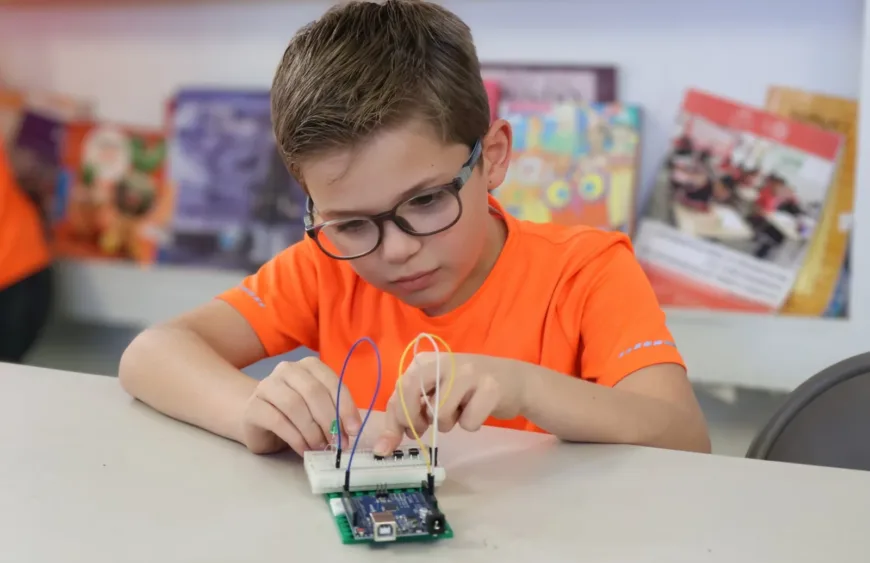
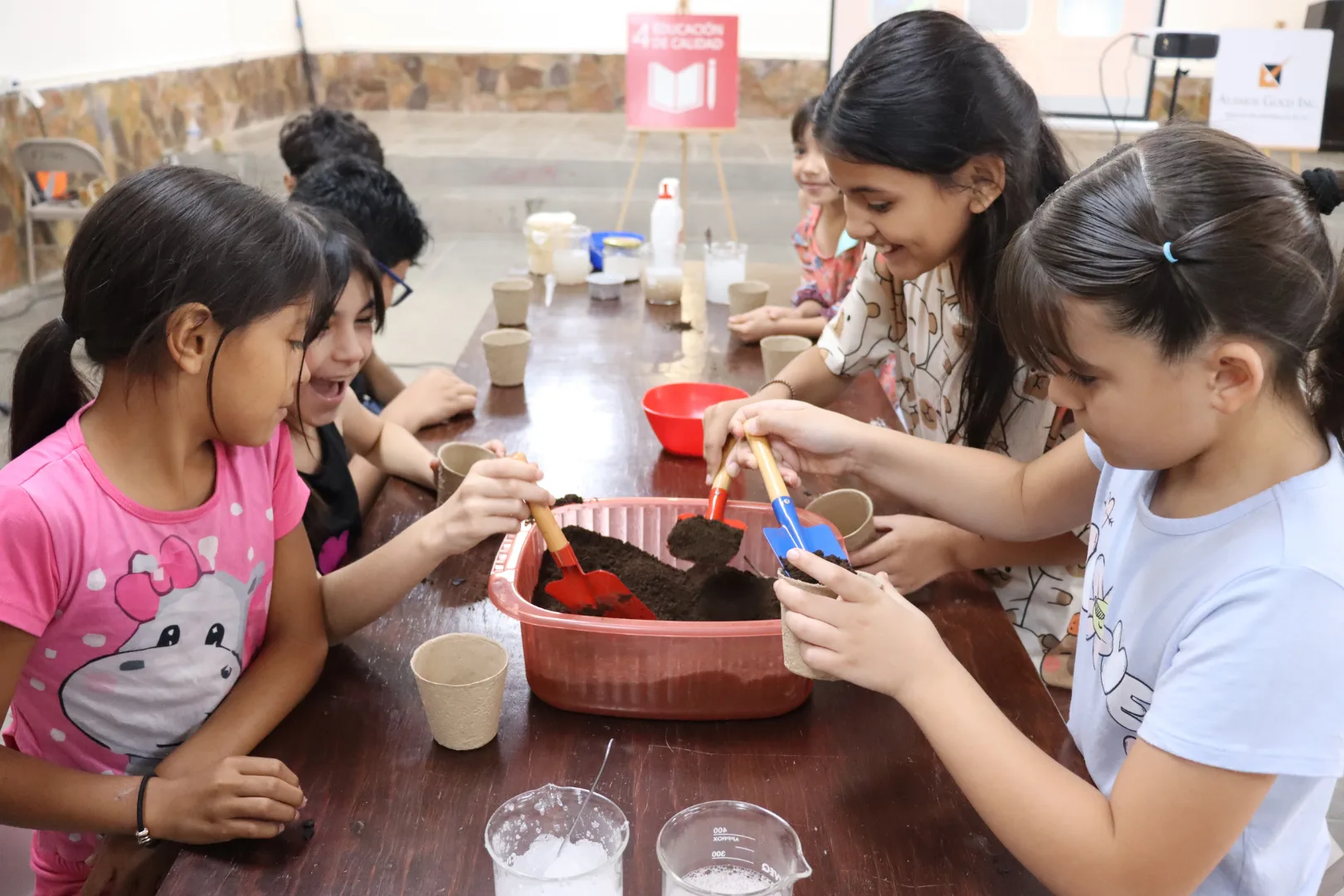
En el Verano Científico, la niñez aprende creando, experimentando y trabajando en equipo. Foto: Dimex Ideas.
A summer to create, experiment, and lose the fear
If one thing is clear, it’s that creativity isn’t protected by keeping it under lock and key, it’s cultivated by putting it to work. And there’s no better ground for that than a space where creating with your hands is the center of everything. That’s exactly the idea behind the Dimex Science Summer camp, a program designed so girls and boys from first grade of primary school to second grade of secondary school awaken their curiosity through experiments, tech challenges, and projects that bring together science, technology, engineering, art, and mathematics, what we know as STEAM education.
In its third edition, the Science Summer camp adds experiences with Virtual Reality and Artificial Intelligence, but always hands-on: chemistry, physics, biology, robotics, programming, and even storytelling. The second round starts Monday, August 10, 2026 at the Dimex lab in Hermosillo, with limited spots for 20 participants per session. You can find dates, schedules, and how to enroll on the Science Summer camp page.
Creativity is cultivated, not inherited
The fear so many families feel toward artificial intelligence is legitimate, and hey, it’s also a good sign: it means we care that our daughters and sons keep being people who imagine, who create, and who think for themselves. The survey reminded us of something we sometimes forget: creativity is one of the few skills AI can’t fully copy, and one that can also be trained.
So the next time you’re tempted to forbid, try the opposite. Pull out the paints, set up an experiment, make up a story, throw yourselves into a family project. In the face of AI, the most powerful answer we have is still the same one it’s always been: create.
Empantallados y GAD3. (2024). El impacto de la IA en la educación en España. Familias y escuelas ante la Inteligencia Artificial. Empantallados. https://empantallados.com/ia/