If you have a daughter in primary school, you’ve probably seen her overflowing with questions: why does it rain, how does a plane fly, what’s inside a battery. That curiosity is exactly the raw material of science. The problem is that, according to the most recent evidence, many of those girls stop seeing themselves as scientists long before they reach high school. The STEM gender gap (science, technology, engineering and mathematics) doesn’t suddenly appear in college: it builds up from the earliest years of school, which is why it’s worth understanding and addressing it in time.
A new UNICEF Mexico study, published in 2026, put numbers and testimonies to something many families already sensed. Here we’ll tell you what it found, why primary school is such a key stage and, above all, what concrete things moms and dads can do at home so their daughters (and their sons too) don’t switch off that curiosity.
What the new UNICEF study says about the STEM gender gap
The document is titled “Barriers to the inclusion, participation and access of girls to STEM” (in Spanish) and it’s a knowledge, attitudes and practices study carried out in 11 Mexican cities: Tijuana, Mexicali, Mexico City, Chihuahua, Ciudad Juárez, Toluca, Acapulco, Chilpancingo, Guadalajara, Monterrey and San Luis Potosí. The sample covered primary, secondary and upper-secondary school, precisely to see at which point along the path the gap opens up.
The most striking figure is about early aspirations: according to the data cited by UNICEF, at age 15 some 28% of boys say they want to study science or engineering, versus just 9% of girls. And when those generations reach graduation, the imbalance persists: in the 2021-2022 school year around 175,000 students graduated from STEM programs at public institutions, but only 34.5% were women, according to official figures cited by the United Nations in Mexico (in Spanish). The report’s conclusion is clear: by the time a career is chosen, the decision has been in the making for a long time.
Why primary school is the stage that weighs the most
Here’s the point that sometimes slips past us. The gap isn’t that girls find science harder. UNICEF’s own report on technical training, produced together with the ILO and Movimiento STEM, says it plainly: girls are good at science and mathematics (in Spanish), but they report more insecurity about their own abilities. In other words, the brake isn’t skill, it’s confidence and the messages they receive.
And those messages start early. A comment like “that’s for boys,” a science toy that always reaches the brother first, or simply not knowing a single female scientist, all shape what an 8- or 9-year-old girl believes is possible for her. In primary school curiosity is still in charge; by secondary school, many have already opted themselves out. In fact, a UNICEF-backed initiative in Mexico notes that girls start losing confidence in their STEM abilities as early as ages 8 to 12. That’s why acting in time, while the doubt can still be dismantled, makes all the difference.
The three barriers that hold girls back
The study groups the obstacles into three broad types, and they’re worth knowing because each one is tackled differently:
Structural barriers. These have to do with the system. The teaching staff interviewed reported a reduction in the hours devoted to STEM subjects and a shortage of teachers for mathematics. In 8 of the 11 states, a lack of infrastructure and equipment for robotics or computing workshops was also detected, according to coverage by Fábrica de Periodismo (in Spanish).
Sociological barriers. These are the ones from home and the community: pigeonholing women into caregiving roles and comments that discourage. The report warns that 4 out of 10 female students don’t perceive positive reinforcement from their families for their STEM learning. The good news here is that families are also part of the solution.
Psychological barriers. The lack of role models. In several states, very few students could name a single female scientist. If you don’t see her, it’s hard to picture yourself there. That’s why showing real, close, attainable examples works so well.
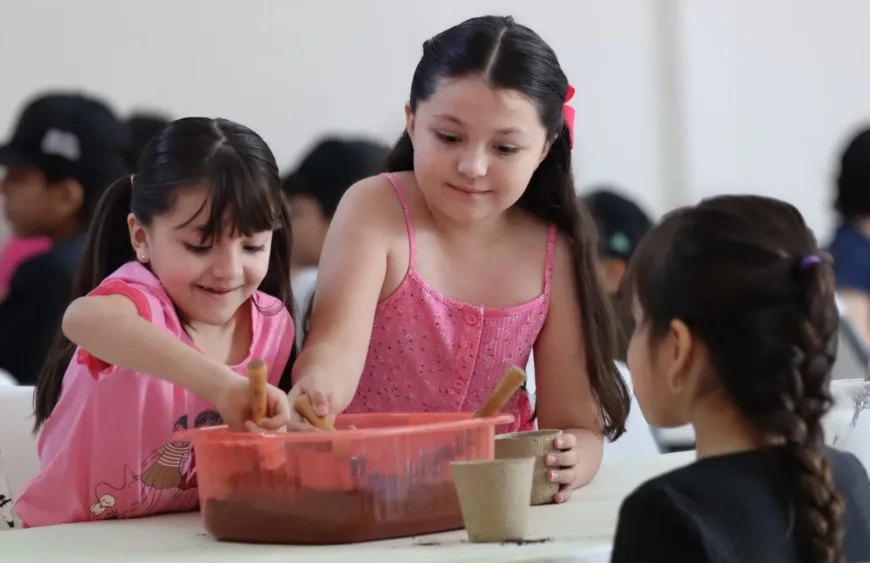
Tener referentes y experiencias prácticas ayuda a que las niñas se imaginen a sí mismas en la ciencia. Foto: Dimex.
What families can do in time
The hopeful part of the study is that the gap can be narrowed, and much of the work happens at home, without needing a laboratory. A few simple ideas that really move the needle:
Take her questions seriously. When your daughter asks why it rains (in Spanish) or how something works, instead of giving the answer right away, turn the question back to her: “how do you think it works?” That trains the habit of investigating before concluding.
Watch the language. Avoid “that’s for boys” and share building toys, science kits and any tasks that involve constructing or measuring equally between girls and boys. The small, repeated messages are the ones that weigh the most.
Give her role models. Look up stories of women in science and engineering together, both famous and close to home. Seeing someone like you doing what they love is a huge boost to confidence.
Let her make mistakes. Science is trial and error. An experiment that “goes wrong” isn’t a failure, it’s data. Learning to normalize error protects exactly the confidence the study found to be so fragile in girls.
And something deeper: turn curiosity into method. Observing, asking, testing and drawing conclusions can be practiced, just like a sport. That’s what’s called STEM or STEAM education (in Spanish), and paired with strategies like project-based learning (in Spanish), it becomes second nature.
Scientific thinking isn't inherited, it's trained
This is the heart of the matter. Scientific thinking isn’t a talent you’re born with: it’s a tool that can and should be developed from an early age, with practice and support. When a girl learns to ask questions, design a small experiment, analyze what happened and share it, she stops wondering whether she’s “good at this” and simply does it. That’s where the gap starts to close.
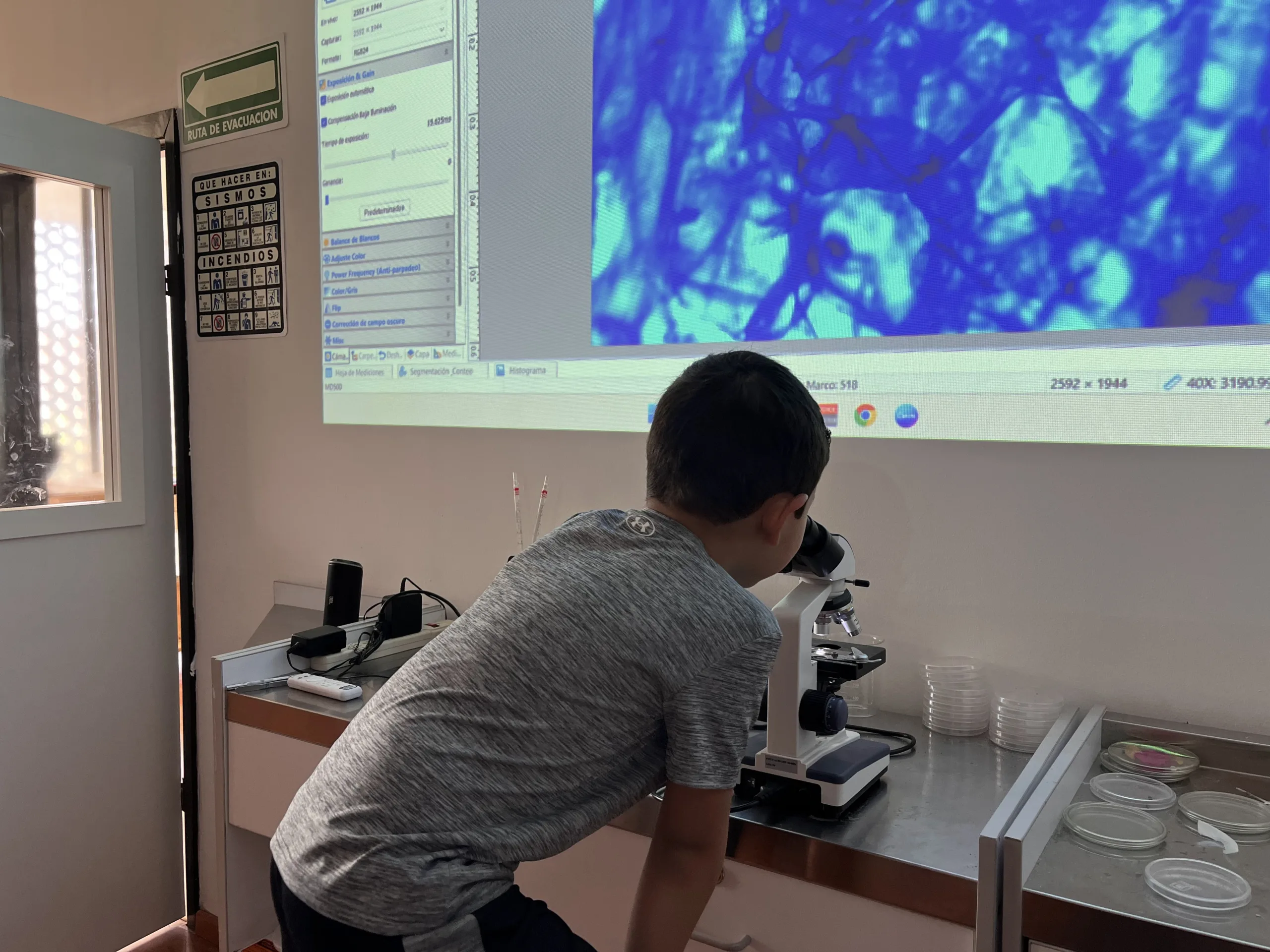
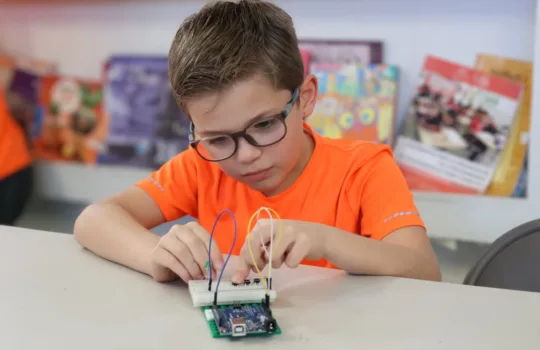
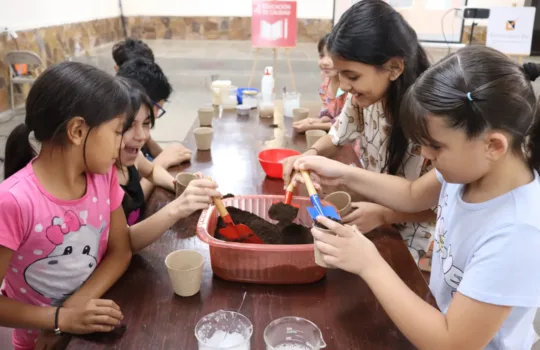
At Dimex we work on exactly that with primary-school girls and boys in our course Scientific Thinking: From Theory to Practice (in Spanish). It’s more than 20 experiments in physics, chemistry, biology, robotics and engineering, designed so they take part hands-on, make mistakes without fear and discover that science is for them too.
We’re a nonprofit and we publish the dates and costs of each edition as they open. If you’d like to know when the next one is, or learn who we are (in Spanish), reach out on WhatsApp and we’ll gladly tell you all about it.
The STEM gender gap starts small, in primary school, almost without our noticing. The good news is that it’s fought small too: with questions that are well received, with role models, with permission to make mistakes and with real chances to get hands-on with science. In time, it can still be done.